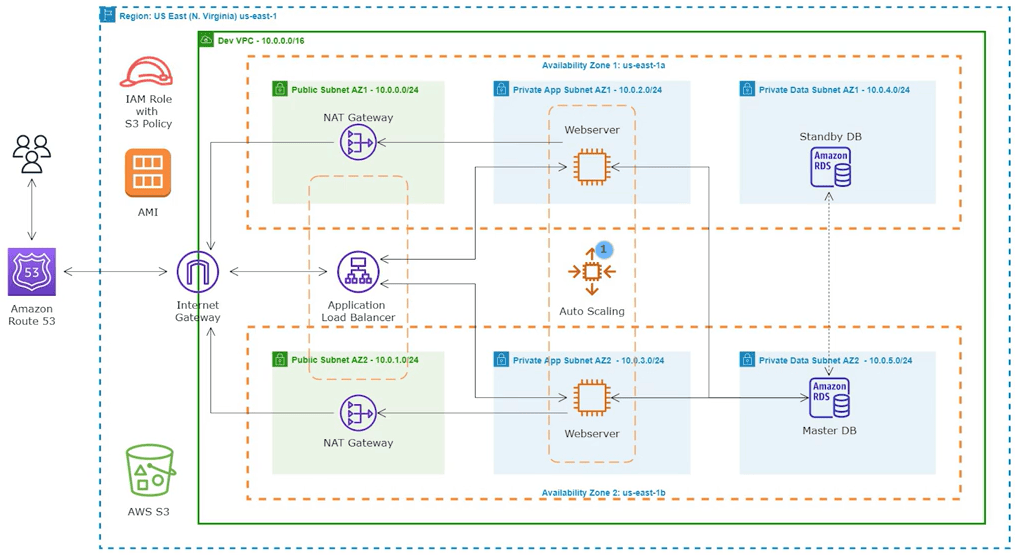
This project epitomizes my dedication to hands-on learning in contemporary web hosting practices, utilizing the robust capabilities of Amazon Web Services (AWS) alongside the infrastructure-as-code tool Terraform.
This initiative aims to construct a resilient, multi-tier infrastructure to support my dynamic ecommerce website. Leveraging Terraform's declarative syntax, I meticulously design and provision AWS resources, ensuring scalability, fault tolerance, and security across the entire stack.
The project unfolds with careful consideration for network architecture, where I configure a Virtual Private Cloud (VPC) with multiple subnets. In the first public subnet, I deploy a load balancer to distribute incoming traffic across the web servers. Subsequently, I establish a private subnet housing the web servers, shielding them from direct external access. Finally, I set up at least one database instance using Amazon RDS in the second private subnet, ensuring secure data storage and management.
The highlight of my learning journey is Amazon ECS, a fully-managed container orchestration service that streamlines the deployment and scaling of containerized applications. Through hands-on experimentation, I configure ECS clusters, define task definitions, and deploy Docker containers onto Amazon EC2 instances seamlessly. With ECS's robust features such as automatic load balancing, service discovery, and auto-scaling, I gain proficiency in optimizing resource utilization and enhancing application scalability.
Within this infrastructure, Amazon EC2 instances form the backbone of the web server tier, hosting the ecommerce application. Employing AWS Auto Scaling, I dynamically manage EC2 instances to adapt to fluctuating demand, with Amazon Simple Notification Service (SNS) topics configured to receive notifications from autoscaling actions.
Through Terraform's automation capabilities, I streamline the deployment and configuration of AWS resources, ensuring consistency and repeatability in the infrastructure setup. As I deploy my dynamic ecommerce website onto this robust infrastructure, I validate its functionality and resilience, preparing it to handle real-world traffic and demands.
This project not only enhances my technical acumen but also deepens my understanding of cloud architecture principles and best practices. By embracing Terraform as a means of infrastructure as code, I empower myself to efficiently manage and scale my ecommerce infrastructure on AWS, laying the groundwork for future ventures in cloud computing and web hosting.
In conclusion, this project equips me with the skills and knowledge to architect and deploy resilient, multi-tier infrastructures on AWS using Terraform. Armed with this expertise, I am poised to navigate the complexities of web hosting with confidence and proficiency, driving innovation and success in the digital realm.